The second project of Implementation of Digital Signal Processing (IDSP), done with Mathijs Polman. The assignment builds on the IIR filter from Project MAP: instead of just scheduling the data-flow graph (DFG), you transform it first (retiming, pipelining, look-ahead) to get a faster design.
Previous: Project MAP · Next: Project GFS
TRA-1: Retiming and pipelining
The original DFG has a critical path of 7 clock cycles. We moved the middle delay elements forward twice, first through m2–m5 and then through p3 and p4. That brings the critical path down to 4 cycles.
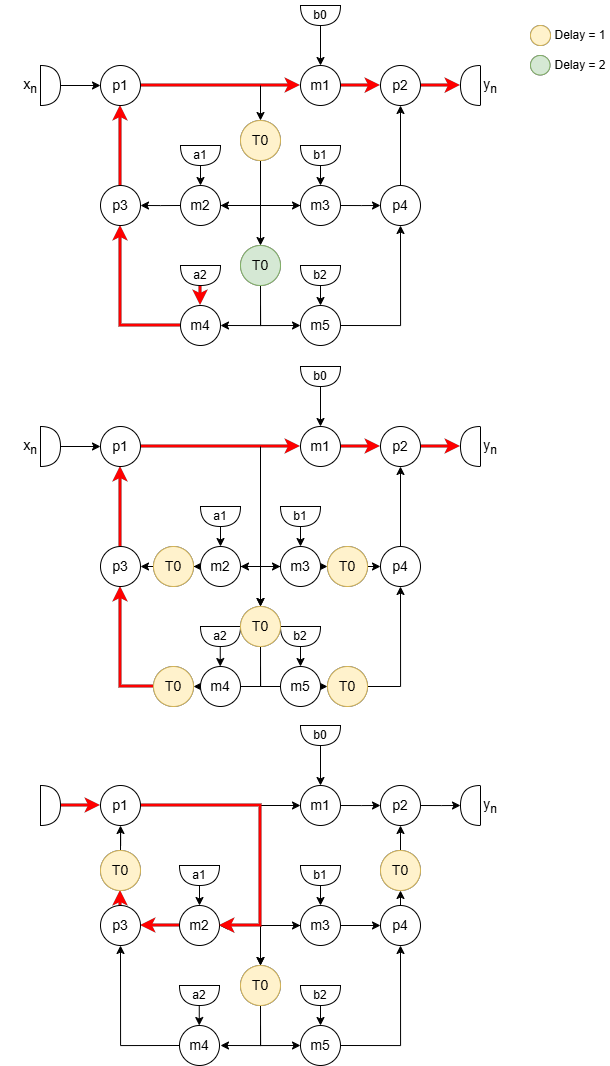 The retiming steps.
To check the behaviour didn’t change, we compared the difference equations. Originally,
For pipelining we looked at the iteration period bound:
The critical loop (top left) has 4 cycles of propagation delay and one delay element, so the bound is 4: equal to the critical path. Pipelining feed-forward cutsets therefore won’t help. To go faster we have to change the transfer function itself, which is what look-ahead does.
TRA-2: Arx model
We modelled the retimed DFG in Arx in the data-flow style of sec_df2.arx. Its output matches the earlier designs.
TRA-3: Look-ahead transformation
From the transfer function
the recursive part of the filter is
p1 is the bottleneck (
Now
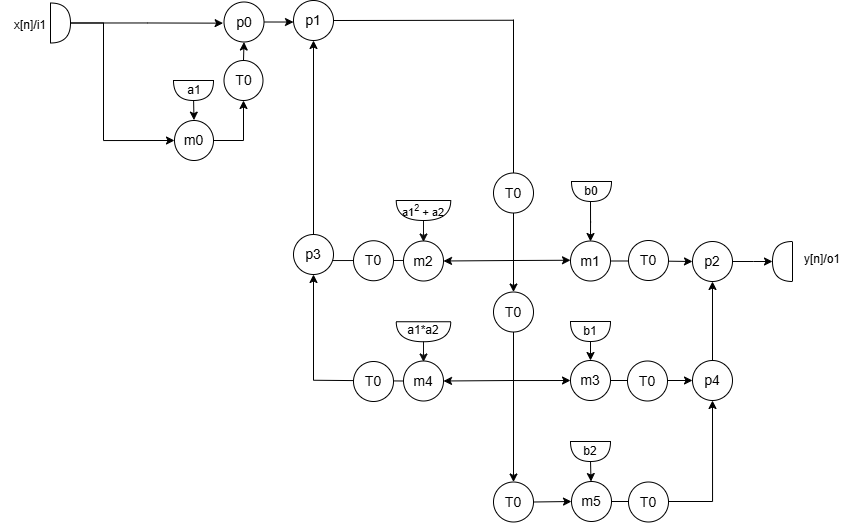 The pipelined look-ahead DFG.
TRA-4: Simulating the look-ahead design
Because of the extra pipelining and look-ahead, the filter takes a few more samples before it produces output. Apart from that time shift, the output matches the original filter.
TRA-5: Rate-optimal overlapped schedule
A multiplication takes 2 cycles and the new iteration period is also 2 cycles, so multipliers can’t be shared. With 5 additions in 2 cycles we need at least