Capacitive Recursive DAC
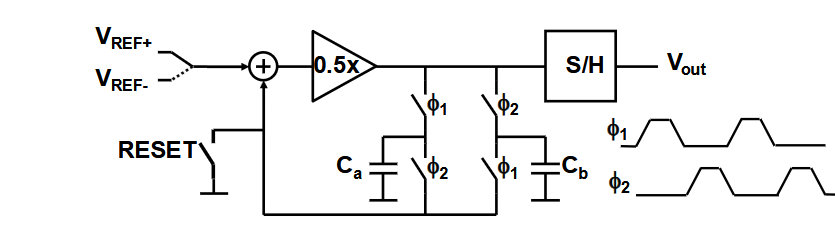
The capacitive recursive DAC is mostly used in algorithmic ADCs. Rather than implementing all bit weights simultaneously with separate components, it works iteratively: each step adds the current bit’s contribution, scaled by
LSB-first (gain
Starting from the least significant bit, the recursive accumulation is:
Bit weights therefore run from
MSB-first (gain
The same structure applies when the gain factor is replaced by
Which approach is better?
Designing for a gain of
Capacitive DAC
Capacitors are the most precisely matched components available in CMOS processes, which makes them a natural fit for DAC implementations. Resistive approaches such as R-2R ladders are less suitable here because large parasitic capacitances distort the intended resistor ratios, a bridge capacitor can be used as a workaround, but it adds complexity.
Capacitive DACs can be realised at low power since there is no static current path, but they do require some form of output buffer to drive a load.
D/A Converter Types
Among DAC architectures, current-steering is the fastest, capable of reaching conversion rates of around
A practical challenge with pulse-based outputs is that sharp edges are needed when two pulses appear close together, otherwise they blur into one another. The return-to-zero (RTZ) DAC addresses this by ensuring that after every bit’s on-time pulse, the output explicitly returns to zero before the next pulse begins. This guarantees a clean transition regardless of the bit pattern.
Sigma-delta feedback: why 1-bit?
In a sigma-delta modulator the feedback DAC is preferred to be 1-bit. The reason is linearity: a 1-bit DAC has only two output levels,
ADC Accuracy
The accuracy of an ADC is fundamentally tied to the ratio
For the analog steps to be equally spaced, the components that set those levels must be equal, matching quality directly determines linearity. Accuracy is limited at several levels simultaneously: batch-to-batch variation, wafer-to-wafer variation, and component-to-component variation within a single die.
Physical origin: doping fluctuations
In a
Two regimes of variation are important to distinguish. Global variation shifts both devices in the same direction, so the effect largely cancels when the two are compared. Local variation shifts each device independently, producing a genuine imbalance between them.
Mismatch model
The total average dopant dose
Area and matching
From the mismatch model (slide 93), the threshold voltage mismatch between two transistors follows:
where
The mismatch coefficient is on the order of